Shan Human Rights Foundation
Large Chinese lead mine north of Tachileik releasing deadly toxins into Ruak tributary
October 21, 2026
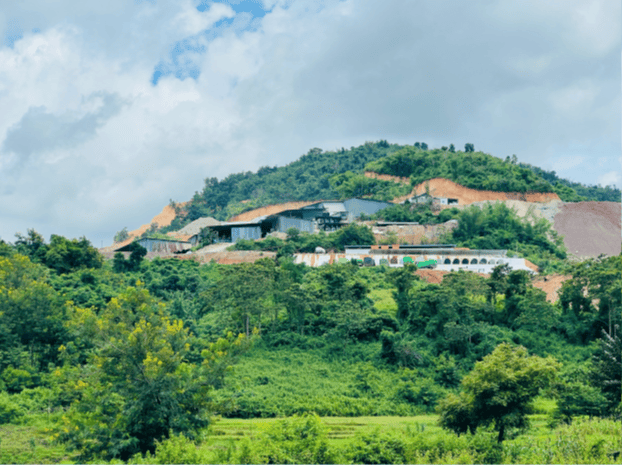
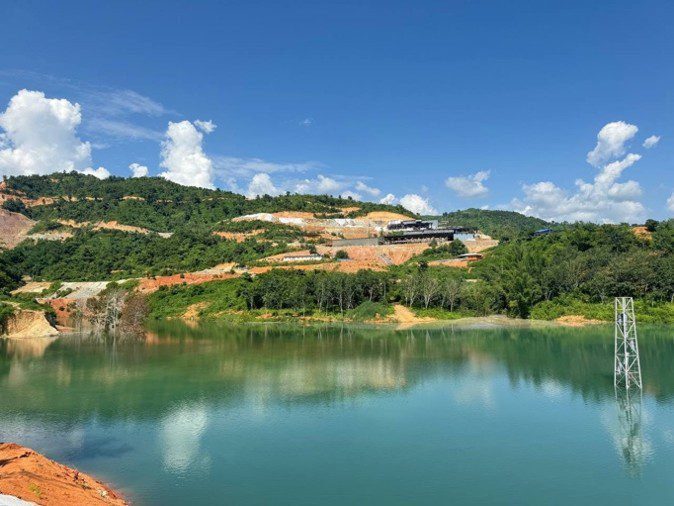
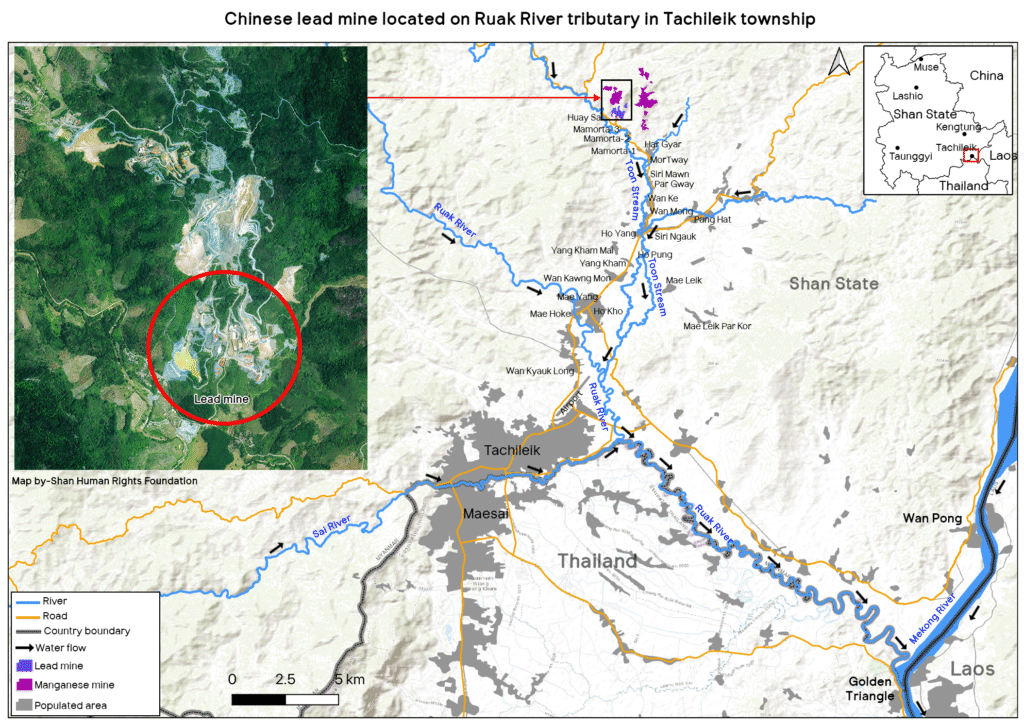
A large Chinese-owned lead mine in Mong Ko tract, 15 kilometers north of Tachileik town, is releasing toxins into the Nam Toon stream, a Ruak River tributary, with deadly impacts on local Akha, Lahu and Shan communities. The Ruak River flows along the northern Thai border before joining the Mekong River at the Golden Triangle.
Lead mining began in this Burma Army-controlled area in 2021, next to existing manganese mines which had been operating since 2007 – and which SHRF previously reported were contaminating the Ruak River. Large amounts of manganese ore were transported each year by truck across the border into Maesai then to Thailand’s Laemchabang Port (over 135,000 tons in 2019), from where it was shipped to China.
According to Maesai customs records, lead ore started being imported into Thailand (from Mong Ko) in June 2023. Thai export data shows lead ore started to be exported from Thailand to China, Laos and Cambodia in 2023, with export amounts, mainly to these countries, increasing fivefold in 2025. It thus appears that the lead ore from Mong Ko has largely transited Thailand, but some may also have been used inside Thailand (where lead is needed to produce lead-acid batteries, a vital component of the automobile industry).
The lead mining at Mong Ko was originally carried out by two main companies with permission from Naypyidaw: Sai Wanna Company and Sein Naw Mining Company, but the former Sai Wanna mine (directly north of the Sein Naw mine) is no longer extracting lead, only manganese. The lead ore is thus now being extracted exclusively by Sein Naw Mining Company, and is being exported by truck to Thailand via the 2nd Maesai River Friendship Bridge.
Sein Naw Mining Company is headquartered in Tachileik, and has been registered as a domestic company with Burma’s Directorate of Investment and Company Administration since 2011. The first official director was Eike Kyin, a United Wa State Army (UWSA) officer. The current managing director is Eike Kyin’s former Shan wife, Nan Shan Naw. However, the management and technical staff at the mining site are Chinese, and inside sources say the actual owners are from China.
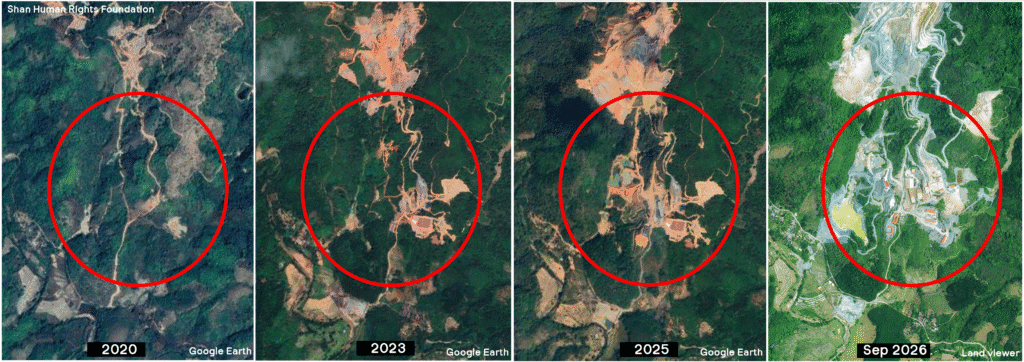
Timelapse imagery shows the expansion of the Sein Naw Mining Company lead mine during the past six years. The imagery reveals that the Sein Naw mining site also contained a gold leaching facility, but this has fallen into disuse during the past few years.
Lead is being excavated at the Sein Naw site in underground tunnels, which reportedly stretch for 3 to 4 miles. Above ground, there are machines for crushing the lead ore, and chemical separation facilities. The machinery is powered by generators.
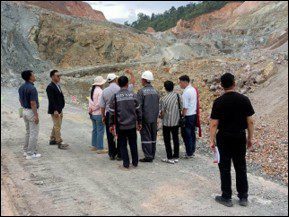
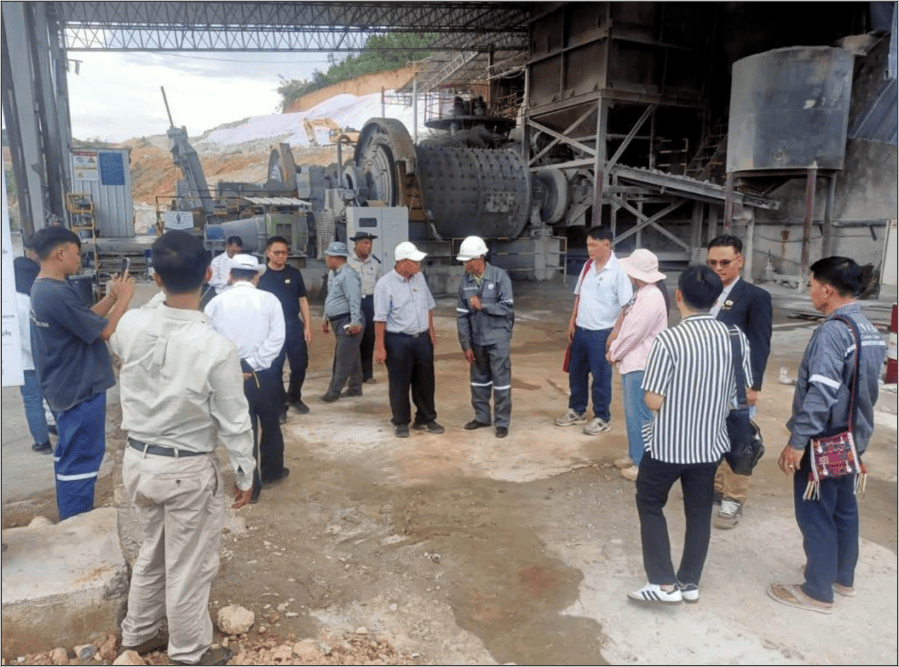
A Facebook post of a recent visit to the lead mine on July 24, 2026 by U Sai Khattiya, Chair of the Shan State Parliament’s Forestry, Minerals, Natural Resources, Environmental Conservation and Protection and Electricity Affairs Committee, showed photos taken at the site, including machinery. However, no tunnels were shown.
There are about 100 personnel employed at the site. The management and technical staff are Chinese, but the mine workers are from Burma. The monthly wage of a local mine worker is about 10,000 baht. The workers rotate in eight-hour shifts, throughout the day and night.
The mining site is guarded by security personnel of the United Wa State Army (UWSA), and outsiders are strictly forbidden from entering.
In July 2026, locals say that a tunnel collapse caused the death of about 20 mine workers, but the incident was hushed up.
Lead ore is loaded into sacks at the mining site then transported in six-wheel trucks down to a village called Adin, four kilometers north of Tachileik town, where the ore is transferred onto 24-wheel lorries, which carry the ore across the 2nd Maesai River Friendship Bridge into Thailand. Locals say that the mineral depot at Adin is owned by the UWSA.
Deadly impacts of lead mining on local villagers already suffering from manganese mining
Villagers in the Mong Ko hills have suffered for nearly 20 years from the impacts of manganese mining. The mines have caused deforestation and loss of hill farms. Sediment runoff from the mines has smothered lowland farms, making them uncultivable. The mining trucks have damaged roads and caused accidents. Noticeable impacts of contamination of the Nam Toon stream have been the dying off of fish and other aquatic organisms, and skin infections among local villagers. There is very likely to have been heavy metal ingestion by villagers through contamination of crops irrigated by the Nam Toon stream, but this has not been measured.
In the past few years, since the start of lead mining in this area, villagers living along the Nam Toon downstream of the mines have been suffering more acute impacts, assumed to be due to inhalation or ingestion of lead, or of chemical substances released from processing lead. There have been increased cases of miscarriages and of birth defects (details withheld for security reasons). Dozens of buffaloes, cattle and pigs have died suddenly after drinking from the Nam Toon stream (20 buffalo of one owner died in July 2026 alone).
Exposure to lead is extremely harmful. It can cause pregnant women to suffer miscarriages or fetal damage, and can cause children to suffer irreversible damage to brain development. In both adults and children, it damages the kidneys, cardiovascular system, nervous system and reproductive organs.
Chemicals, usually xanthates, used to separate lead ore at mining sites are also highly toxic. One of the main gases released by xanthates during the separation process is carbon disulfide, a toxic vapour that can cause severe damage to nervous, cardiovascular and reproductive systems.
Villagers living closest to the mines face the highest risk of direct inhalation of lead particles or chemical vapours in the air. Villagers living next to the mines say there is often a foul smell of sulfur coming from the mines, likely from the chemical separation process, meaning that potentially poisonous vapours from this process are reaching their lungs.
Villagers may inhale lead dust blown directly from ore at the mines, or from dried residue of runoff flowing into areas downstream of the mines.
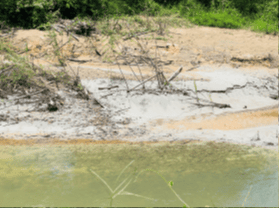
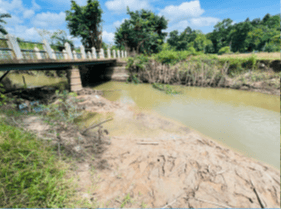
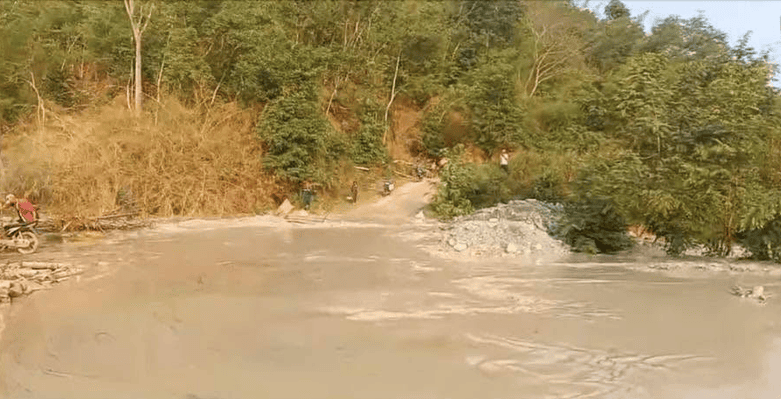
Tailings ponds at the Sein Naw site have several times collapsed during the rainy season, sending muddy tailings across the southern edge of the Akha village Huay Sa into the Nam Toon stream. The mud deposits, once dried, have increased the risk of lead inhalation for local residents.
Even without collapse, the tailings ponds have regularly spilled into and contaminated the Nam Toon stream, likely causing the high toxic levels that have killed off animals drinking from the stream.
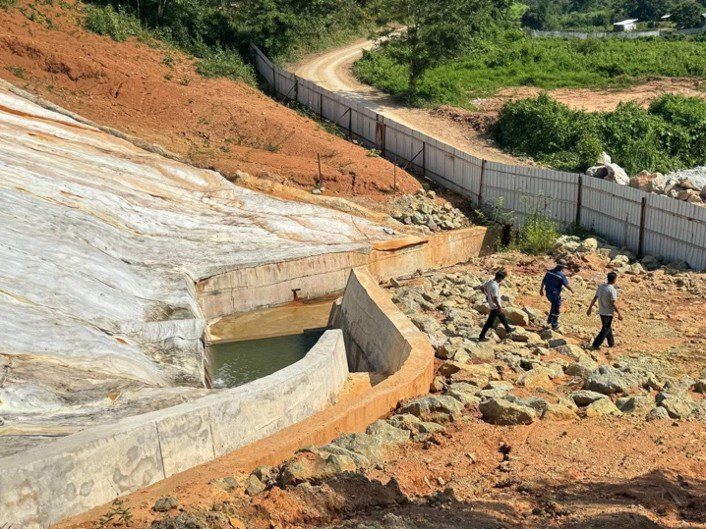
Following another tailings pond collapse in July this year, a large new concrete reinforced barrier was built next to Huay Sa village to contain the lead mine’s main tailing pond.
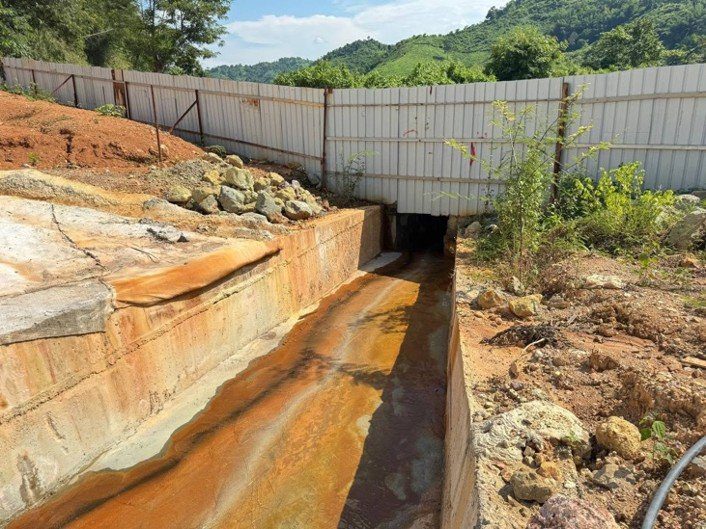
However, built into the foot of the barrier is a sluice gate which locals say regularly flushes out foul-smelling effluent from the pond. The sluice gate feeds into a concrete drainage channel (behind a corrugated iron fence, thus not visible from the road) then through an underground concrete pipe into the Nam Toon stream below Huay Sa village.
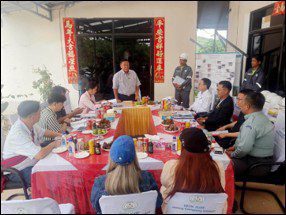
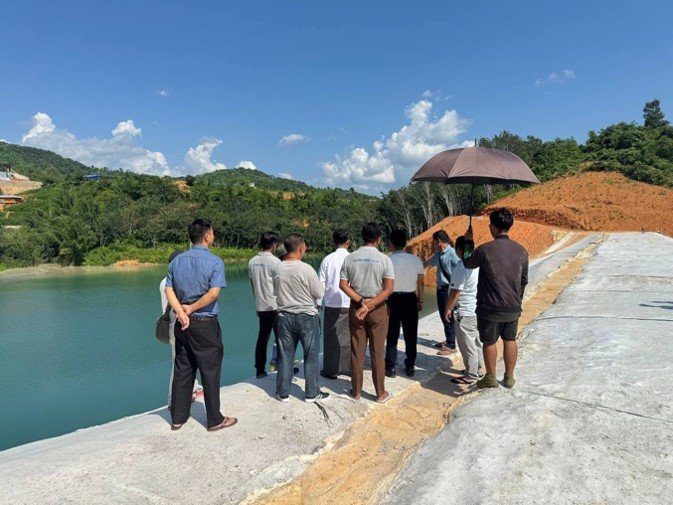
As a result of locals’ complaints about the discharge from the mine, on September 2, 2026, U Kyaw Nyein Aung (Union Solidarity and Development Party MP for Tachileik), U Wilson Moe (Shan State Minister for Lahu Ethnic Affairs), and various township officials visited the Sein Naw mining site “to verify whether proper measures were in place to prevent factory wastewater from flowing into local farmlands.” Even though photos from the visit (posted on a Facebook account) showed the group walking along the tailings pond barrier and the drainage channel below (with visible evidence of discharge from the pond), the officials’ findings on the wastewater issue have not been made public.
Failure of Sein Naw company to adhere to Burma’s mining laws and environmental regulations
Sein Naw company is clearly operating in violation of national mining laws and environmental regulations, as can be seen from the company’s Environmental Compliance Certificate (ECC), issued by Burma’s Ministry of Natural Resources and Environmental Conservation (MONREC) on October 24, 2025.
Mining outside permitted area
The ECC shows that Sein Naw was granted an official permit by MONREC to extract lead in two plots: 9.3 acres and 9.2 acres in size. However, the actual lead mining area extends far beyond the boundaries of these plots.
Tunnelling without permission
The type of mining described in the ECC is only open pit mining. However, Sein Naw is carrying out extensive tunnelling at the site (far outside the permit area).
Failure to transparently monitor water, air and noise impacts of the mine
According to the ECC, Sein Naw company is supposed to scientifically monitor water, air and noise impacts at the mine, and report findings every six months to MONREC. Then, within 10 days of reporting to MONREC, these monitoring results are supposed to be made publicly available. It is specifically stated that Sein Naw company must test water quality around the mine for “pH, Fe, Suspended Solid, Lead, Arsenic, Copper, Mercury and other parameters”.
However, locals say they are not aware of any such testing being carried out by the company, or any test results being made public.
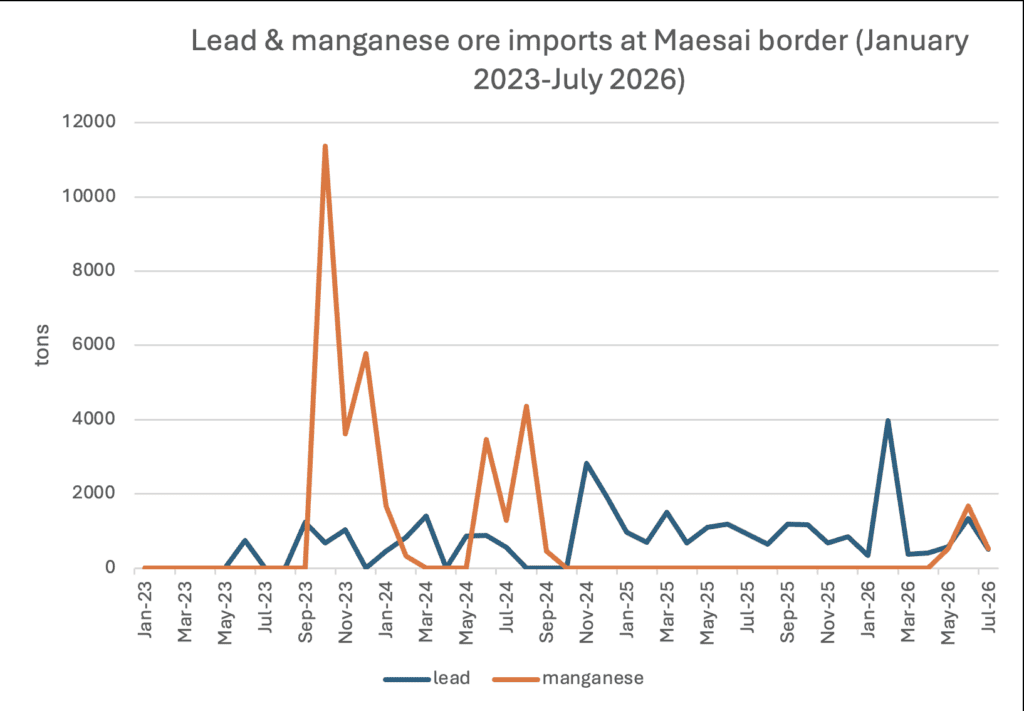
Thai customs records show lead ore imports overtaking manganese ore imports from Burma at Maesai over past two years
Maesai customs data shows that lead ore (from the Mong Ko mines) started being imported into Thailand in June 2023, and has been imported almost every month since then, reaching a peak amount of nearly 4,000 tons in February 2026.
When lead started being imported in June 2023, manganese ore from Mong Ko had stopped being imported through Maesai since August 2022. Manganese imports resumed between October 2023 and September 2024, but stopped again between October 2024 and May 2026, before resuming again. Currently, the two main companies extracting manganese in Mong Ko are Sai Laung Hein Mining Company and Nwe Oo Ya Nan Company.