


Update by the Shan Human Rights Foundation
May 18, 2026
Chinese rare earth mines in eastern Shan State using trafficked Burmese scammers as slave labour
Recent testimony by a trafficking survivor has revealed that rare earth mines operated by a Chinese company in southern Mong Hsat, eastern Shan State, close to the Thai border, are using trafficked Burmese scam workers from Tachileik as slave labourers.
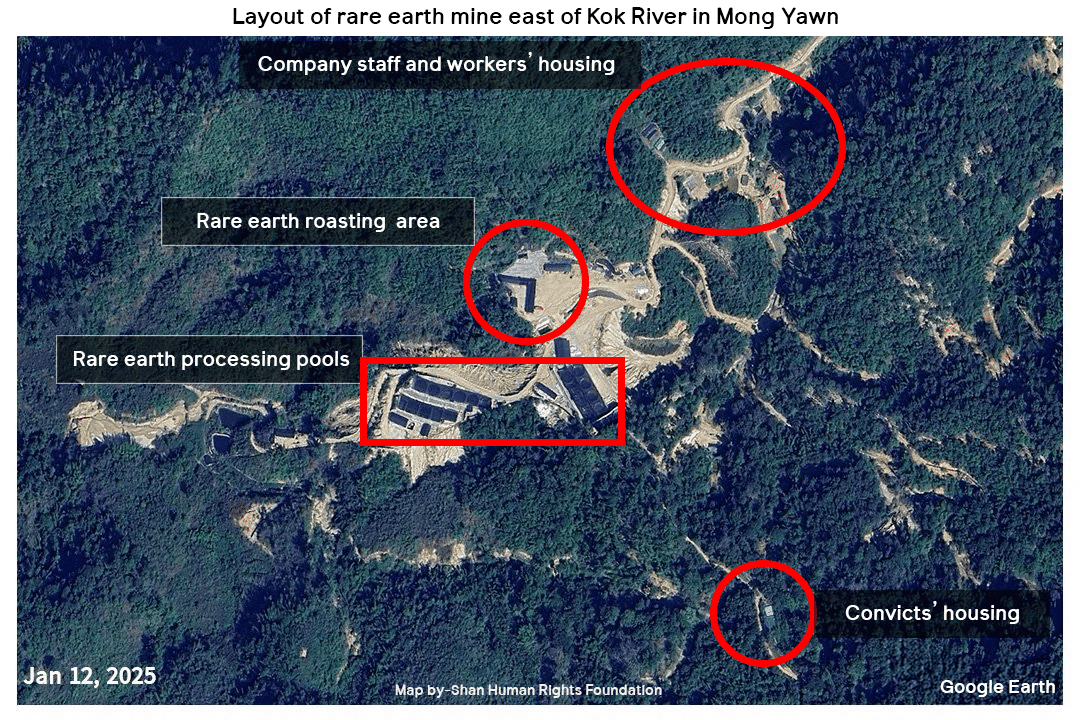
The survivor, “Ko Thet”, was trafficked in April 2025 from a Chinese cyberscam company in the Yaung Ni Oo compound owned by the United Wa State Army (UWSA) in Tachileik town. He had been working there in the accounts department until late January 2025, when he and two of his colleagues were unjustly accused of embezzlement by their Chinese accounting supervisor, and punished by being forced to work as unpaid scam callers. After three months, without warning, all three were transported in a car by a Burmese police officer to Mong Yawn in southern Mong Hsat, handed over to UWSA soldiers, and then driven to a rare earth mine operated by a Chinese company east of the Kok River – about eight kilometers from the Thai border.
The three men were kept detained with about thirty UWSA convicts, some shackled, at the mining site, and together with these prisoners were forced to do hard labour jobs, such as digging earth and carrying loads – sometimes at another rare earth mine operated by the same Chinese company on the west of the Kok River. They were kept apart from the approximately one hundred regular mining labourers, who were from different parts of Burma.
The mine, housing over fifty Chinese mining personnel, was guarded by about fifty UWSA soldiers. One of Ko Thet’s colleagues tried to escape one night, but was captured and beaten, transferred to a UWSA detention centre elsewhere, then moved to another rare earth mine operated by the same Chinese company in Mong Bawk, in the northern UWSA area near the Chinese border. Ko Thet himself spent two months at the Mong Yawn mine before finally managing to escape.
Ko Thet’s testimony gives new insight into the extent to which mines in eastern Shan State are operating completely outside the law. It is already common knowledge that many mines are failing to conform to environmental regulations, and are causing harmful river contamination within and outside Burma’s borders. Now the revelation that Chinese mining operators are linking with Chinese scam syndicates to traffic and enslave Burmese youth as mine workers, exposes not only failures in regulation, but far worse, the handover of Shan State’s lands and resources to criminal-linked foreign investors, whose only interest is to extract profits, irrespective of the costs to the environment and local people’s lives.
This should be a wake-up call to countries in the region suffering from transborder river contamination from mining in Shan State that simply appealing to the Burmese regime to regulate the mines will be futile. The only way that this issue can be meaningfully addressed is for the mining sector to be brought under the control of a genuine federal democratic government that protects the sovereignty of its lands and resources, and prioritizes the well-being of its people.

Background of the scam industry in Tachileik
Although Tachileik is fully under the control of the Naypyidaw authorities, it remains the main hub of online scam operations in southeast Shan State. According to Ko Thet, scam businesses were first set up in Tachileik in 2022, but their numbers sharply increased in late 2023, when many more Chinese scammers relocated to this area to avoid the anti-scam crackdowns in northeast Shan State during Operation 1027.
The cyberscam gangs moving to Tachileik initially set up scamming operations (referred to locally as “naingankya (foreign)-online”) inside existing large online casino complexes, running scamming businesses alongside online casino gaming in these spacious compounds, which usually contained several multi-storey buildings.
By early 2024, Tachileik was gaining notoriety as a new scam hub, and – to be seen to be addressing this problem – the regime authorities began carrying out “crackdowns” on the Tachileik scam operations, raiding selected premises and arresting groups of scam workers, but leaving the scam managers unscathed. Some scam operators temporarily went into hiding in the area, or relocated to other scam hubs, such as Myawaddy or Laos’s Golden Triangle Special Economic Zone, but some simply downsized and moved into less conspicuous premises around Tachileik town, meaning the scam industry in Tachileik never ceased to function.
This pattern of periodic token crackdowns, while letting scam operations persist in one form or another, has continued to this day in Tachileik.

The UWSA’s Yaung Ni Oo scam compound
Ko Thet’s trafficking ordeal began at one of the most well-known of the large scam compounds in Tachileik: the “Yaung Ni Oo Resort”, in Hawng Luek quarter, in the eastern part of Tachileik town. It is located next to the UWSA’s Tachileik liaison office, and the whole compound is owned and controlled by the UWSA.
This compound, originally known as “Fish Pond” (due to the large artificial pond at the site), first gained notoriety in 2006, when the Shan Herald Agency for News revealed in an investigative report on the drug trade in Shan State that Bao Youhua, the youngest brother of UWSA leader Bao Youxiang, had stayed there from November 2003 to February 2004, during which time he detained at the site 113 yaba dealers who had failed to pay their debts to the UWSA. The compound had been purchased by the UWSA from a rival druglord who had been gunned down by competitors in 1997.
The SHAN report revealed that there were already two casino halls, a karaoke bar and a motel at the Fish Pond site in 2006. Twenty years later, an array of multi-storey buildings has been erected within the compound.

Ko Thet had been working for one of the multiple Chinese scam companies within the Yaung Ni Oo compound. He, like many Burmese attracted by the comparatively high income, was recruited to work willingly, and did not suffer ill treatment initially – beyond being confined to living and working within the confines of the compound (where armed guards maintained security throughout the premises). Only after being unjustly accused of embezzlement, did he suffer the same treatment as other trafficked scam workers: namely being kept locked up and forced to make scam calls, then suffering physical punishment (in his case being forced to do squats) if he did not meet his targets.
The ability of the Chinese scam syndicates to run large-scale, abusive operations within the Yaung Ni Oo compound right inside Tachileik town has undoubtedly relied on significant pay-offs to the regime authorities.
This was corroborated by a staff member of the Tachileik General Administration Department, who revealed the inside story of a recent police raid at the Yaung Ni Oo Resort on February 4, 2026, which had been triggered by widespread Chinese social media exposure of mistreatment of Chinese workers at the site. He said that 150 Chinese nationals, mostly trafficking victims, were arrested during the raid, but over 300 Chinese scam operators, running at least five companies inside Yaung Ni Oo, paid 50,000 to 100,000 baht each to the police and other authorities, and were able to relocate elsewhere, within and outside Tachileik, to avoid the crackdown.

Rare earth mining in Mong Yawn
The existence of the two rare earth mines in Mong Yawn, southern Mong Hsat, was first exposed by SHRF on May 15, 2025. Historical satellite images show ground preparations for the rare earth mine 3.6 kilometers east of the Kok River (to which Ko Thet was trafficked) began in mid-2023, and those for the rare earth mine 2.6 kilometers west of the Kok River started in mid-2024.
On October 26, 2025, SHRF revealed that a Chinese state-backed company, Chinese Investment Mining Company, was behind these rare earth mines in Mong Yawn.
Ko Thet was able to identify from satellite imagery the different sections of the rare earth mine where he was based, including the buildings where he and other convicts were housed, about 300 meters southeast of the main processing area.
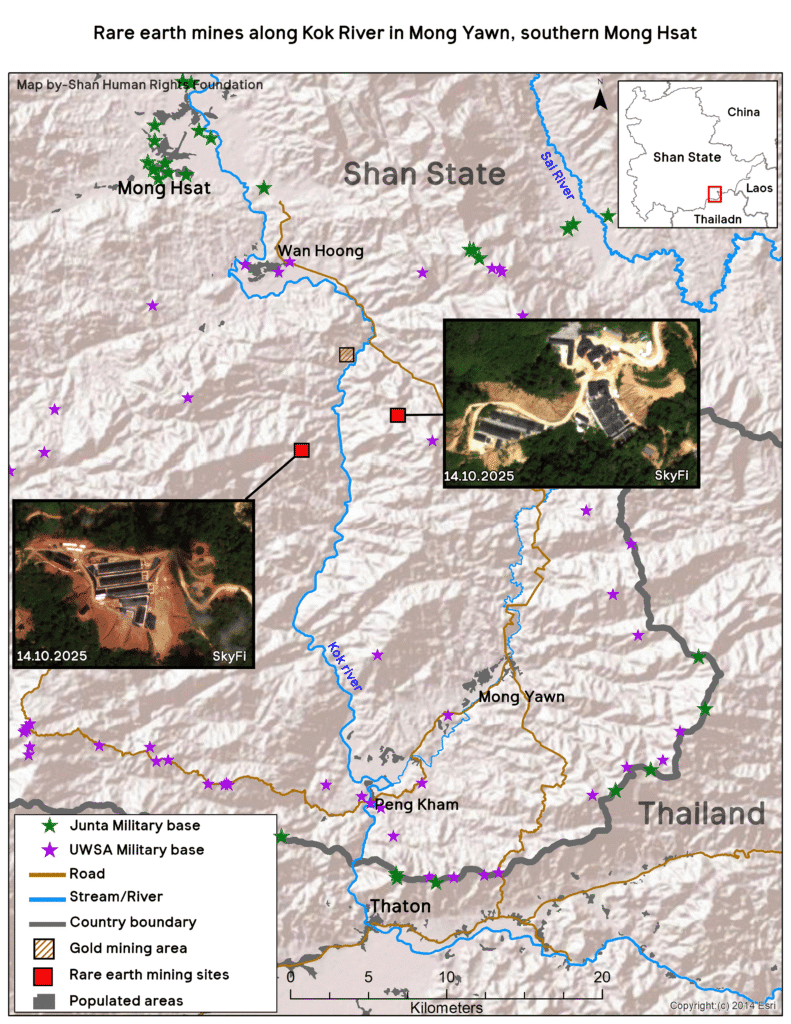

The fact that security at the two rare earth mines in Mong Yawn was provided by UWSA soldiers shows that direct control of the mines is under the UWSA. However, Ko Thet’s experience of being transported to Mong Yawn from Tachileik by a Burmese police officer points to the key role of the regime authorities in facilitating all the logistic arrangements for the mines – namely transport of equipment, materials and personnel along the regime-controlled roads between Tachileik and Mong Yawn.
Thus, it is nonsensical for the regime to claim that it cannot enforce regulations at the mines as they are under UWSA control. The regime authorities have the ability to halt the mining operations at any time by blocking transport to and from the mines, and are evidently receiving significant financial incentives to allow the mining to continue.
Testimony of “Ko Thet” (not his real name), interviewed by SHRF in early 2026
I am 25 years old and a local resident of Tachileik. After the 2021 coup, I stopped attending school. At the beginning of 2022, ‘Kyar Pyan‘ (online scam) businesses started arriving in Tachileik, and since then, I have been moving from one company to another for work. The bosses of these companies were always Chinese.
Initially, it was just basic scamming work—making calls, replying to messages, and answering inquiries. As I gained more experience, I reached a level where I could handle hacking software and manage financial accounts. Following ‘Operation 1027,’ at the beginning of 2024 — I don’t remember the exact date — crackdowns in Tachileik became very strict. My company decided to move to Laos, in the Golden Triangle SEZ. At the time, I wasn’t in good health, so I didn’t relocate with them, and stopped working for a bit.
At the end of 2024, a Burmese colleague from a previous scam company where I worked came back to recruit me, saying they were going to start operations again. That’s how I ended up working for the company in the Yaung Ni Oo compound where my current problems began. Even though crackdowns were intense at the time, we worked quietly inside the compound.

I joined as an assistant accountant. We lived in dormitories inside the compound. Our accounting team consisted of four people: a Chinese lead accountant, myself, “Ko Myo” (from Rakhine State), and “Sai Mein” (from Muse). We used English to communicate with the Chinese staff.
My job was to assist with the bookkeeping, while the other two were responsible for transfers, inflows and outflows of money. The first two months went smoothly. But at the end of January 2025, our Chinese lead accountant left, and a Chinese woman from Hong Kong took over. From the start, she was extremely difficult and condescending, and the whole team clashed with her. The manager frequently had to mediate.
The major conflict happened on March 8. It was my girlfriend’s birthday, so I didn’t go to work and stayed in my room on the phone. Around 3 pm, the assistant manager and two security guards came to my room and told me they ‘had business’ with me.
When I reached the manager’s office, Ko Myo and Sai Mein were already there. The Chinese accountant and the manager accused Ko Myo and Sai Mein of making an incorrect transfer and accused me of hiding the records. We denied it, but they wouldn’t listen. We asked for proof and requested to check the CCTV, but both the manager and assistant manager ignored us. They only listened to the Chinese woman and the records she presented because she was of the same nationality. The manager told us we had to pay back the ‘missing’ 43,000 yuan. When we said we didn’t have that kind of money, they told us we’d have to speak to the boss. They confiscated our phones and locked us in a room inside the compound.
The next afternoon, the company boss arrived. His name was Yan Huiming. He was originally from Yunnan and had been in Tachileik since about 2022. He gave us an ultimatum: pay back the money by working without a salary or he would report us to the police for being ‘Kyar Pyan‘ workers. We were afraid that we might be forcibly conscripted as soldiers once handed over to the police. We had no choice but to work without pay. I was moved from the accounting department back to the call centre.
We tried to find a way to escape, the company had its own security, and there were armed guards throughout the compound. Even though it’s inside Tachileik, it’s a place no one can just enter. While working at the call center, they would force us to do squats as punishment on days we didn’t meet our targets.

Around the third week of April, after the Thingyan festival, we heard the police were going to raid the compound. So our bosses prepared to move us. The manager told us we had been ‘transferred’ to another company. He said if we wanted to go home, we had to pay our ‘debts.’ It was clear we were being sold.
I tried to contact home, but how could my family have that much money? It was even worse for Ko Myo; his home is in a war zone in Rakhine, so he couldn’t even make contact. Only Sai Mein said his family would try to find the money. The manager spoke to us, and the following evening, a Hilux station wagon came to pick us up. There was a driver and another man in the front of the car, and in the back were the three of us and one of the Chinese staff from our company who was assigned to escort us.
At first, we thought we were just being sold to another scam company. Once we got in the car, one of the two men in the front, who spoke Burmese, showed us a pistol and said if we tried anything “funny”, he would kill us.
I realized we were heading west in the direction of Mong Hsat. When we got to the main military and police checkpoint on the western edge of Tachileik, they searched our car. At the checkpoint, the man from the front seat — who I assumed was an important figure — got out and saluted the main police officer at the gate. After he went over to talk to them, they let us through without any inspection.
That was when I realized he was a policeman. Later, when I returned to Tachileik, I saw him frequently at various checkpoints. I found out his name was Win Kyaing from the Anti-Human Trafficking Task Force, and he was a sergeant.
They drove all night without even letting us stop for the toilet. By the next morning, we were in Mong Yawn, which is controlled by the Wa (UWSA). There, another vehicle with UWSA people came to get us. They gave us breakfast and then drove us for about an hour to a mine. The car that dropped us off went back.
That was when we realized we had been sold to work in a mine. From the outside of the mine, you wouldn’t think there were any armed men, but in reality, it was full of armed Wa soldiers in uniform. They kept us detained, mixed in with UWSA prisoners who were also being forced to work. There were about thirty of these prisoners: Chinese, Wa and Bama men. Some were kept in chains, and had to sleep in wooden stocks at night. They didn’t let us mix with the regular paid workers. There were about 100 of the regular workers – Bama, Shan, Wa, Akha and Lahu. They were too afraid to talk to us.
There were between 50 to 60 Chinese personnel at the mine. They were in charge of the mining operations. There was a Burmese interpreter, but the main language spoken in the day to day running of the mine was Chinese.
The job of the regular laborers was to pour chemicals into the pipes in the hills and to process the minerals. We and the prisoners had to do the hard labour jobs of digging and carrying sacks and metal drums of various substances. Only after I started working, did I learn that the mine was extracting rare-earth minerals. There was a strong chemical smell at the site, and we were given masks by the UWSA soldiers to wear while working.
The place where we stayed was in a valley, separate from the other labor barracks. When we had to go up the mountain to do digging, a truck came to pick us up.
At the mine, there was also a separate place where they roasted the rare earth. We were restricted from this area except when we were made to load sacks of the roasted rare earth onto trucks.
The mine where we stayed was east of the Kok River. I went twice to the other rare earth mine west of the river, with about 30 of the prison labourers, to do some digging. They drove us by truck to the river, which we crossed by raft, then another truck drove us to the mine.
We were fed two meals a day — you can imagine the quality of the food. It was usually just rice soup or steamed buns with boiled vegetables.
After about two weeks, Sai Mein and one of the prisoners tried to escape at night. They were caught that same night. After that, they took our phones away. Sai Mein and the other guy were beaten with sticks by Wa soldiers. They called everyone out to watch; they tied them to a tree and beat them. Then they left them tied to the tree all night. It was summer, so they survived; if it had been winter, they might have died.
The next day, they were put in chains and sent to a UWSA detention center elsewhere. I don’t know what happened to the man who ran away with him, but at the request of the mining boss who had bought us, Sai Mein was then sent to work at another of his rare earth mines in Mong Bawk.
I finally got access to a phone again in early May. By my own means, I managed to get out of there on June 18. I had to ask my family for the bus fare from Mong Yawn to get home.
(Note: Ko Thet explained the specific details of his escape to SHRF, but these have been omitted at his request for his safety.)
Later, around mid-July, Sai Mein’s family used money and a connection with a militia to go and buy him back from Mong Bawk. I heard that he recently went to work in Shweli from Muse, but got into a fight there, and is now in a Chinese prison.
As for Ko Myo, about two months after I was released, I lost contact with him. I don’t know if they just took his phone away again or if something happened to him.
Download Full Report (PDF)
Signal Contact